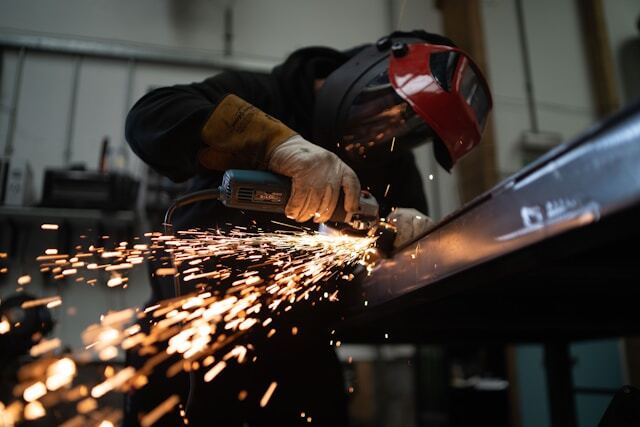
First off, choose a good cutoff tool for your application. One of my favorites is the 12v battery operated Bosch (I have zero affiliation, I just like them and have used them the most.) One of the main reasons I like it is for it’s dexterity. The battery is small and lightweight, but it still has enough juice to handle most cutting situations. Otherwise if you need to be able to cut or grind for extended periods and need a bit more power, a good plug-in dremel is usually able to handle any chore as long as you’re patient. If you want to get real fancy, or you’re doing a lot of cutting and or grinding, consider getting a pneumatic pen style handle and bits. There’s really nothing like wielding a pen to remove material at your whim. (shapeways work story) But, keep in mind, rotary pneumatic tools tend to chew through air compressor capacity, so you’d better have something more than a pancake compressor unless you want to be listening to the sound of a lawnmower the whole time you’re working.
My next tip about cutoff tool work, I’m going to get right into one of the most important things right off the bat, you need to stabilize.
The tool wants to walk, assuming it’s rotating clockwise, it’s going to want to walk to the right if you’re pressing down from above, or to the left if you’re pressing up from below. The degree to which it wants to walk depends on how hard you press, and how hard you press can be tricky to gauge, especially as you’re just getting used to using the tool. So my suggestion, when you’re starting out and really just in general, move the cutting wheel into the material slowly and gently, while gripping the tool firmly with both hands and pulling slightly counter to which direction you expect it to walk. Balance the firm grip with the gentle touch.
You want to plan for the walk, and here’s the real trick. Fixture the thing you’re cutting so you have plenty of access, if you can of course. Next, plan a way to rest your forearms onto something stable relative to what you're about to cut, like the thing itself for example. But even a chair or some books moved to a good spot can make for a solid perch to stabilize yourself.
Now that your forearms are planted, you can use just your hands and fingers to firmly grip the tool and gently push into the material.
Try to work on finding a natural axis of rotation with your hands, in line with the rotation of the wheel. Once you get comfortable with this you’ll be able to cut more or less straight cuts through thick material with relative ease.
The tool wants to walk, assuming it’s rotating clockwise, it’s going to want to walk to the right if you’re pressing down from above, or to the left if you’re pressing up from below. The degree to which it wants to walk depends on how hard you press, and how hard you press can be tricky to gauge, especially as you’re just getting used to using the tool. So my suggestion, when you’re starting out and really just in general, move the cutting wheel into the material slowly and gently, while gripping the tool firmly with both hands and pulling slightly counter to which direction you expect it to walk. Balance the firm grip with the gentle touch.
You want to plan for the walk, and here’s the real trick. Fixture the thing you’re cutting so you have plenty of access, if you can of course. Next, plan a way to rest your forearms onto something stable relative to what you're about to cut, like the thing itself for example. But even a chair or some books moved to a good spot can make for a solid perch to stabilize yourself.
Now that your forearms are planted, you can use just your hands and fingers to firmly grip the tool and gently push into the material.
Try to work on finding a natural axis of rotation with your hands, in line with the rotation of the wheel. Once you get comfortable with this you’ll be able to cut more or less straight cuts through thick material with relative ease.
So, cool, now you’ve got a good tool, you’ve got your work fixtured, you’ve braced your arms or wrists or hands on something solid near your workpiece. The next thing you can work on is touch.
Limit your active grinding / cutting time to 5-10 seconds at a time, with a few seconds in between to let the cutting wheel cool. This will also let the tool spin back up to speed and cool itself.
Move the wheel along your axis of rotation to areas of the material where the cut is shallower, there is less friction here so your tool works more efficiently, with less drag against the sides of the wheel for the motor to contend with
This also helps prevent causing angular pressure on the cutoff wheel, which could cause it to break and potentially shatter.
Limit your active grinding / cutting time to 5-10 seconds at a time, with a few seconds in between to let the cutting wheel cool. This will also let the tool spin back up to speed and cool itself.
Move the wheel along your axis of rotation to areas of the material where the cut is shallower, there is less friction here so your tool works more efficiently, with less drag against the sides of the wheel for the motor to contend with
This also helps prevent causing angular pressure on the cutoff wheel, which could cause it to break and potentially shatter.
Next, one of my favorite topics, fixturing. And now I’m not talking about just the workpiece, which as I’ve mentioned I think is also really important. I’m talking about fixturing the tool. If you can fixture your tool such that it’s restricted to only following a certain path relative to your object, you can get some really great results on the cheap.
Here, the rotary tool is fixtured in a vice. Now I can gently move my workpiece into the cutoff wheel to achieve the cut I need.
Check out this table mounted rotary tool jig which lets me use it like it was an anywhere-mountable miniature table-saw. I’ve posted a link below to the STL’s for it if you want to print it for yourself. I’ve included jigs which work for the two tools I mentioned earlier. Let me know in the comments if you’d like to see versions to fit other products in the future!
If your workpiece holding situation allows it, you can rotate the work-piece in place to achieve spectacular cuts through surprisingly thick material. Here is a 40mm cutoff wheel cutting through 1” steel rod stock. What is up!? Rod! Stock! What you got?1/? *Bleep*
Sorry about that. I got carried away
Here, the rotary tool is fixtured in a vice. Now I can gently move my workpiece into the cutoff wheel to achieve the cut I need.
Check out this table mounted rotary tool jig which lets me use it like it was an anywhere-mountable miniature table-saw. I’ve posted a link below to the STL’s for it if you want to print it for yourself. I’ve included jigs which work for the two tools I mentioned earlier. Let me know in the comments if you’d like to see versions to fit other products in the future!
If your workpiece holding situation allows it, you can rotate the work-piece in place to achieve spectacular cuts through surprisingly thick material. Here is a 40mm cutoff wheel cutting through 1” steel rod stock. What is up!? Rod! Stock! What you got?1/? *Bleep*
Sorry about that. I got carried away
Which leads me to my next cutoff wheel tip; being prone to getting carried away can be dangerous, and “Safety squinting” when we should be planning for the worst and preparing is not a great long-term strategy, so I really want to emphasize safety here as my final Cutoff-wheel tip
The number one safety item I’d start out with is Eye protection. And, I’d even go one further here and say face protection is really Key. Cutting wheels remove lots of material really quickly, quicker the better, and that high rotation (video of rotations at high speed) can fling things (show corner of metal flying off) really, really hard.)
So let me recommend something I’ve come up with, a fog-resistant, scratch-resistant, millimeter thick polycarbonate face shield which looks pretty sick, and adds a decent amount of face protection against things like flying shards of metal. I’ve included a link in the description to where you can order your own faceshield kit, which lets you upgrade your existing awesome baseball hat (show montage of funny baseball hats) or get a sweet new specially-designed baseball cap and replacement shields to help protect your next safety-squint-inducing project. Thanks in advance for your support. I really hope you have an epic experience where you’re building something and some part comes flying at your face and bounces off your polycarbonate face shield, and you think, “*bleep* I’m so glad my ex bought me that face shield thing way back when”.
The number one safety item I’d start out with is Eye protection. And, I’d even go one further here and say face protection is really Key. Cutting wheels remove lots of material really quickly, quicker the better, and that high rotation (video of rotations at high speed) can fling things (show corner of metal flying off) really, really hard.)
So let me recommend something I’ve come up with, a fog-resistant, scratch-resistant, millimeter thick polycarbonate face shield which looks pretty sick, and adds a decent amount of face protection against things like flying shards of metal. I’ve included a link in the description to where you can order your own faceshield kit, which lets you upgrade your existing awesome baseball hat (show montage of funny baseball hats) or get a sweet new specially-designed baseball cap and replacement shields to help protect your next safety-squint-inducing project. Thanks in advance for your support. I really hope you have an epic experience where you’re building something and some part comes flying at your face and bounces off your polycarbonate face shield, and you think, “*bleep* I’m so glad my ex bought me that face shield thing way back when”.
Just another tidbit about safety with regard to using a cutoff wheel.
There is a pretty standard safety protocol for dealing with rotary tools of just about any kind. Don’t wear gloves.
Gloves can get caught in spinning objects. And powerful spinning objects like drill presses or grinding wheels or the like can wrap your glove, and then your hand, and then your arm, and then your body, until you’ve bounced off the machine several times and likely broken many bones along the way. (show closeup of OSHA report, Reddit pages)
Despite that, I think of cutoff wheels, especially battery operated ones, as a bit of an exception to this rule. If you’re wearing gloves thick enough, a cutoff wheel with skitter off your glove, and you’ll be at worst lightly scuffed, rather than cut or seriously abraded. If your glove were to get sucked in, the tool wouldn’t have enough torque to pull you in and would just stop. Again, better than grinding into your flesh.
I say, wear gloves if it makes you feel more comfortable, but make sure if you do wear gloves, you still have the dexterity to have a firm grip of the tool, and you don’t develop a false sense of security. You can still get messed up if you’re careless.
Take care!
Denis
There is a pretty standard safety protocol for dealing with rotary tools of just about any kind. Don’t wear gloves.
Gloves can get caught in spinning objects. And powerful spinning objects like drill presses or grinding wheels or the like can wrap your glove, and then your hand, and then your arm, and then your body, until you’ve bounced off the machine several times and likely broken many bones along the way. (show closeup of OSHA report, Reddit pages)
Despite that, I think of cutoff wheels, especially battery operated ones, as a bit of an exception to this rule. If you’re wearing gloves thick enough, a cutoff wheel with skitter off your glove, and you’ll be at worst lightly scuffed, rather than cut or seriously abraded. If your glove were to get sucked in, the tool wouldn’t have enough torque to pull you in and would just stop. Again, better than grinding into your flesh.
I say, wear gloves if it makes you feel more comfortable, but make sure if you do wear gloves, you still have the dexterity to have a firm grip of the tool, and you don’t develop a false sense of security. You can still get messed up if you’re careless.
Take care!
Denis
Photo; https://unsplash.com/photos/person-in-black-jacket-holding-brown-wooden-rolling-pin-tXJhAFVOHVk?utm_source=unsplash&utm_medium=referral&utm_content=creditShareLink